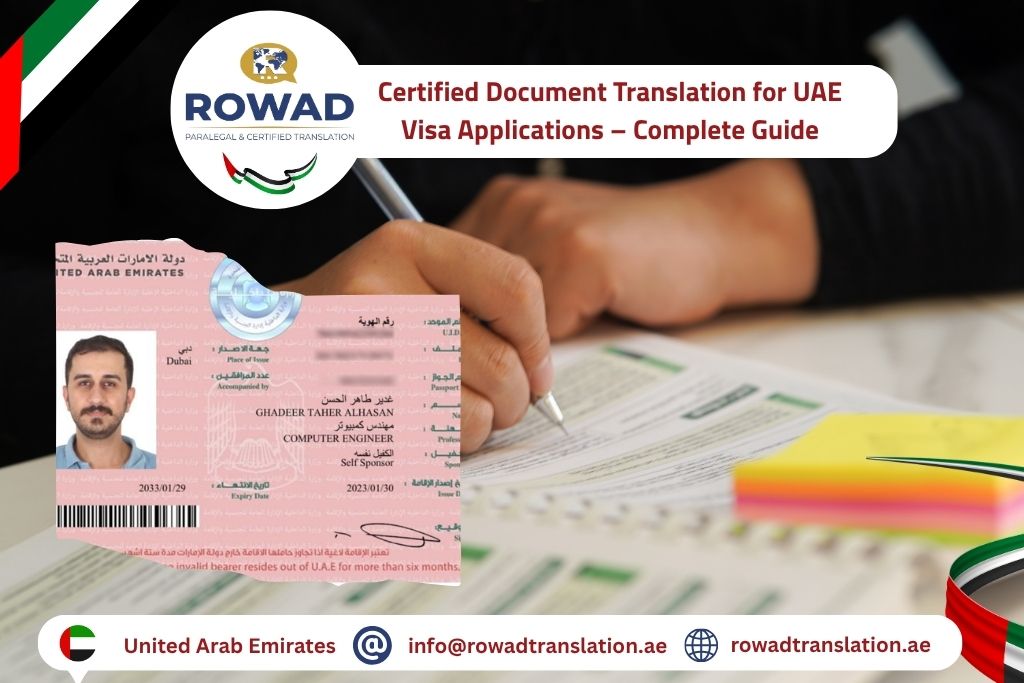
If you are applying for a UAE visa — whether an employment residence visa, family sponsorship, student visa, or golden visa — one requirement that cannot be skipped is certified document translation. The UAE’s immigration authorities, government departments, and courts require that all official documents issued in a foreign language be translated into Arabic by a licensed, government-approved translation office.
This guide covers everything you need to know: which documents require certified translation for UAE visa applications, how the process works step by step, the most common mistakes that cause delays, and how Rowad Translation can help you get it done accurately and on time.
What Is Certified Translation in the UAE?
Certified translation in the UAE is an official translation performed by a translator licensed by the UAE Ministry of Justice or an equivalent accrediting authority. The translated document is accompanied by the translator’s official stamp, signature, accreditation number, and a certificate of accuracy. This stamp is what gives the translation its legal standing — without it, no government body, embassy, or court in the UAE will accept the document.
Certified translation is fundamentally different from regular translation. A regular translation may be linguistically accurate but carries no legal authority. A certified translation, by contrast, is a legally binding document that can be submitted to immigration authorities, the Ministry of Foreign Affairs (MOFA), labour courts, educational institutions, and UAE embassies abroad.
Which Visa Types Require Certified Document Translation?
Employment Residence Visa
When applying for a work-sponsored residence visa in the UAE, your employer or free zone authority will typically request a set of personal and professional documents. Any document issued in a language other than Arabic or English must be certified-translated into Arabic. Commonly required items include academic degrees, experience certificates, employment contracts issued abroad, and police clearance certificates.
Family Sponsorship Visa
Sponsoring a spouse, child, or parent for UAE residence requires submitting documents such as marriage certificates, birth certificates, and sometimes divorce decrees or custody documents. Most of these are issued by foreign authorities in non-Arabic languages and require certified translation before they can be accepted by the UAE immigration authority (ICP or GDRFA).
Golden Visa and Investor Visa
The UAE’s 5-year and 10-year golden visa requires proof of qualifications, property ownership, or business investment. Documents submitted as part of these applications must be certified-translated from their original language into Arabic before being submitted to immigration or the relevant free zone authority.
Student Visa
International students coming to study at UAE universities typically need to translate their academic transcripts, graduation certificates, and sometimes parents’ identification documents. UAE universities and the Ministry of Education require certified translations for all foreign academic credentials.
Medical Treatment Visa
In some cases, particularly medical treatment visas, foreign hospital reports or clinical records may need to be certified-translated. Accuracy of medical terminology in these translations is especially important and requires a translator experienced in medical language.
Documents Most Commonly Requiring Certified Translation for UAE Visas
Birth Certificate
One of the most commonly translated documents in the UAE. Birth certificates are needed for family sponsorship, school enrolment, banking procedures, marriage registration, and children’s residence visas. It is critical that the name on the translated birth certificate matches exactly the name as it appears on the applicant’s passport — any discrepancy is a common cause of visa file rejection.
Marriage Certificate
A marriage certificate issued outside the UAE needs certified translation before it will be accepted by the UAE Personal Affairs Department or when applying for a spouse’s residence visa. The complexity increases when the marriage certificate is in a language other than English or Arabic — such as Russian, French, Thai, Filipino, or Hindi — requiring a specialist translator in that language pair.
Academic Certificates and Transcripts
University degrees, secondary school certificates, and academic transcripts required for employment, professional licensing, or academic admission in the UAE all need certified translation. Bodies such as the Federal Authority for Government Human Resources and university accreditation bodies only accept documents translated by licensed offices.
Police Clearance Certificate (Good Conduct Certificate)
Many UAE employers and government entities require a police clearance certificate from the employee’s home country as part of the visa application. If this certificate is issued in a language other than Arabic or English, it must be certified-translated into Arabic before submission.
Experience Certificates
Proof of professional experience from previous employers abroad is often required for work permits, employment visas, and golden visa applications based on professional achievement. Experience certificates issued in foreign languages must be certified-translated to be legally recognised in the UAE.
Medical Reports and Health Certificates
Medical reports required for certain visa categories need precise certified translation that preserves all medical terminology accurately.
Company Documents and Business Contracts
Employment contracts issued abroad, company incorporation documents, and commercial papers submitted by investors or managers applying for business residence visas all require certified translation. Accuracy in translating financial figures, legal clauses, and company names is essential to avoid discrepancies that could cause the visa application to be delayed or rejected.
Step-by-Step: How Certified Translation Works for UAE Visa Applications
Step 1: Identify the Documents Required
Start by checking the exact document list required for your specific visa type from the relevant UAE government authority — whether that is the ICP, GDRFA Dubai, or your sponsoring employer or free zone. This ensures nothing is missed at a late stage.
Step 2: Attestation in the Country of Origin
Before most official documents can be used in UAE visa applications, they need to be attested. This typically involves getting the document certified by the relevant authority in the issuing country, then by the UAE Embassy or Consulate in that country. Upon arrival in the UAE, some documents also require MOFA attestation.
Step 3: Submit the Document to a Licensed Translation Office
Once your document is attested, submit it to a licensed translation office. Rowad Translation accepts original documents, certified copies, or clear high-resolution scans in many cases, depending on the document type and the receiving authority.
Step 4: Certified Translation by a Licensed Translator
A Ministry of Justice-licensed translator performs the complete translation and attaches the official office stamp, their signature, and accreditation details. This step is the core of the process and is what makes the translation legally valid in the UAE.
Step 5: Ministry of Justice Stamp (If Required)
Some government bodies require an additional Ministry of Justice stamp on the certified translation. Rowad Translation can handle this on your behalf.
Step 6: Submit with the Visa Application
Once you have your certified translation, attach it to the rest of your visa file documents and submit to the relevant authority. Always keep a copy of all translated documents for your own records.
Name Matching: The Most Common Cause of Visa File Rejection
One of the leading reasons UAE visa applications are delayed or rejected is name discrepancy between documents. If your name appears slightly differently on your passport versus your birth certificate or marriage certificate — which often happens when names are transliterated from Arabic, Hindi, Russian, or other scripts into English — the immigration authority may reject the entire file.
At Rowad Translation, we pay particular attention to this issue. Before delivering any translation, we cross-check name spellings across all submitted documents and flag any discrepancy to the client. We also advise on the correct transliteration that aligns with the applicant’s passport, reducing the risk of rejection significantly.
Attestation vs. Certified Translation: Understanding the Difference
Attestation is the verification of a document’s authenticity through a chain of government stamps. Certified translation is the rendering of the document’s content into Arabic, with a licensed translator’s stamp and certification confirming its accuracy. Both are typically required for visa applications, and the order in which they happen depends on the document type and the receiving authority. Rowad Translation can guide you on the correct sequence for your specific documents and nationality.
How Long Does Certified Translation Take?
Under normal circumstances, certified translation of a standard document takes one to three business days depending on the document type, volume, and language pair involved. Rowad Translation offers same-day and urgent translation services for clients facing tight submission deadlines, without compromising on accuracy or compliance.
Certified Translation vs. Online Machine Translation: Why It Matters
Machine translation holds no legal standing. No UAE government body, embassy, court, or accredited institution will accept a machine-translated document. A licensed certified translator brings not only linguistic expertise but also knowledge of the specific terminology used in UAE government documents, MOFA requirements, and immigration procedures. This expertise cannot be replicated by any automated tool.
Who Needs Certified Translation Services Most Often in the UAE?
New expatriate employees relocating to the UAE who need to translate qualifications and experience certificates. Spouses applying for family sponsorship who need marriage certificates and birth certificates translated. Business owners and investors applying for business residence visas or the golden visa. International students applying to UAE universities. Domestic workers whose sponsors need to translate identity and qualification documents to complete the kafala sponsorship procedure.
Why Choose Rowad Translation for Your Visa Document Translation?
Government-Approved and Licensed Translators
All translators at Rowad are licensed by the relevant UAE government authorities, ensuring that every certified translation is accepted by the ICP, GDRFA, MOFA, courts, embassies, and educational institutions.
Over 50 Language Pairs
Whether your documents are in French, Russian, Urdu, Tagalog, Thai, Hindi, German, Spanish, or any of over 50 other languages, Rowad has a specialist certified translator for your language pair.
Strict Name and Data Verification
Every translation undergoes an internal quality review to verify name consistency, date accuracy, and terminology alignment with the client’s other official documents.
Urgent and Same-Day Translation
For clients facing urgent submission deadlines, Rowad offers same-day certified translation without compromising quality or legal compliance.
WhatsApp-First Communication
You can submit your documents, request a quote, and track progress directly via WhatsApp — fast, convenient, and accessible at any time.
Common Mistakes That Delay UAE Visa Applications
Submitting a regular or machine-generated translation instead of a certified one. Name discrepancy between the passport and the translated document due to different transliteration systems. Using an old certified translation that no longer reflects the current document version. Skipping the attestation step before or after translation. Submitting a damaged, illegible, or incomplete document. Leaving the translation to the last minute and not allowing enough processing time before the visa submission deadline.
Rowad Translation helps clients avoid all of these issues through an initial document review before translation begins — flagging any gaps or issues that could affect acceptance before the file reaches the immigration authority.
Frequently Asked Questions About Certified Translation for UAE Visa Applications
Q1: Can a passport itself be certified-translated?
Yes. A passport or a copy of a passport can be certified-translated when specifically requested by a government body or embassy.
Q2: Is certified translation the same as legal translation in the UAE?
The terms are often used interchangeably in the UAE context. Legal translation typically refers to documents of a legal nature such as contracts and court judgements, while certified translation refers to any translation bearing an official translator’s stamp and accreditation. Both are accepted by UAE government authorities.
Q3: Does the document need to be attested before it can be translated?
This depends on the receiving authority. Some require attestation before translation; others accept the translation first and attestation after. Rowad Translation can advise you on the correct sequence for your specific document and intended submission.
Q4: Can a digital document be certified-translated without a physical original?
In many cases, yes — a clear, high-resolution scan can be used for translation. However, some government bodies require a physical certified copy of the translated document to be submitted.
Q5: How do I know if a certified translation will be accepted by UAE immigration?
Ensure the translation is issued by a translation office licensed by the UAE Ministry of Justice, and that it bears the office stamp, the translator’s signature, and their accreditation details. Rowad Translation meets all of these requirements.
Q6: How much does certified translation cost in the UAE?
The cost varies depending on document type, volume, language pair, and turnaround time. Contact Rowad Translation via WhatsApp for an immediate quote.
Q7: Can documents from countries like India, the Philippines, or Russia be translated?
Yes. Rowad Translation handles documents from countries worldwide across more than 50 language pairs.
Q8: Can multiple documents be translated at the same time to speed up the visa application?
Yes, and this is one of the most common requests received. Rowad’s team can process complete multi-document visa files simultaneously to meet tight timelines.
Q9: Is a certified translation from Rowad accepted outside the UAE?
Certified translations issued by UAE-licensed offices are accepted for UAE official use. For use in other countries, additional endorsement or apostille may be required. Rowad can advise based on your destination and use case.
Q10: How do I start a certified translation request with Rowad?
Simply reach out via WhatsApp or the contact form on the website, send a clear copy of your document, and Rowad’s team will respond promptly with a quote and a processing schedule.
Ready to get your visa documents certified-translated by a government-licensed office in the UAE? Contact Rowad Translation now via WhatsApp or submit your document through the contact form — and let our team handle everything from initial review to final certified delivery.