Certified translation of official documents in the UAE is a legal step that residents, expatriates, business owners, and government-facing applicants cannot afford to overlook. Any document issued in a language other than Arabic is rejected by UAE courts, ministries, embassies, free zones, and public authorities unless it is translated by a legal translator licensed by the UAE Ministry of Justice and stamped with their official seal. In this guide from Rowad Translation, we walk you through what certified translation means in the UAE, which documents need it, how the process works, where MOFA attestation and Apostille fit in, and the most common mistakes you must avoid before submitting your paperwork.
What Is Certified Translation of Official Documents in the UAE?
Certified translation in the UAE is more than converting text from one language to another. It is a legally recognised version of an official document, prepared by a translator who is licensed by the UAE Ministry of Justice (MOJ), bearing the office’s official stamp, the translator’s signature, and a formal declaration that the translation is faithful to the original. Without these elements, no UAE authority will accept the document.
Three pillars define certified translation in the UAE: licensing under the UAE Ministry of Justice, mastery of the local Arabic legal terminology used by courts and government departments, and formal acceptance by federal and emirate-level authorities. A translation that lacks any of these elements has no legal standing, regardless of how linguistically accurate it might be.
This is why machine-generated translations, friend-translated documents, and unstamped translations cannot be used for visas, court submissions, embassy procedures, business setups, or family-status applications. Authorities in Dubai, Abu Dhabi, Sharjah, and the rest of the UAE only deal with stamped and signed translations from MOJ-certified offices.
UAE Authorities That Require Certified Translation
Knowing where your document will end up helps you choose the right translation path. The following authorities, courts, and departments only accept officially certified translations in the UAE:
- Ministry of Justice (MOJ): the federal authority responsible for licensing legal translators in the UAE.
- Ministry of Foreign Affairs and International Cooperation (MOFAIC): attests documents going abroad or arriving from outside the country.
- Dubai Courts and Abu Dhabi Judicial Department: require certified Arabic translations in litigation, family cases, and labour disputes.
- General Directorate of Residency and Foreigners Affairs (GDRFA): requires translated documents for residency applications and dependents.
- Notary Public offices: for powers of attorney, declarations, and dual-language contracts.
- Chambers of Commerce and free-zone authorities: for commercial and corporate documents.
- Embassies and consulates: for international visas, attestation, and consular procedures.
- Education authorities: for academic equivalency and university admissions.
- Insurance and healthcare regulators: for medical reports and treatment-abroad approvals.
Each of these bodies has internal procedures and templates that experienced translators in the UAE understand. That is why working with a qualified, MOJ-certified translation office prevents the back-and-forth of rejected paperwork.
Types of Official Documents That Need Certified Translation
The scope of certified translation in the UAE is broad. From a single birth certificate to a multi-volume corporate file, the rule is the same: anything submitted to a UAE authority in a language other than Arabic must be translated by a legal translator. Here are the most common categories Rowad Translation handles every day:
1. Personal and Civil Status Documents
Birth certificates, marriage certificates, divorce decrees, death certificates, name-change documents, family books, and good-conduct certificates. These are needed for residency renewals, dependent visas, family-reunification cases, inheritance proceedings, and overseas visa applications.
2. Academic and Educational Documents
University degrees, transcripts of records, school certificates, IELTS or TOEFL results, vocational diplomas, and equivalency certificates. UAE universities, the Ministry of Education, and most private schools insist on certified translations for any non-Arabic academic record.
3. Identity and Travel Documents
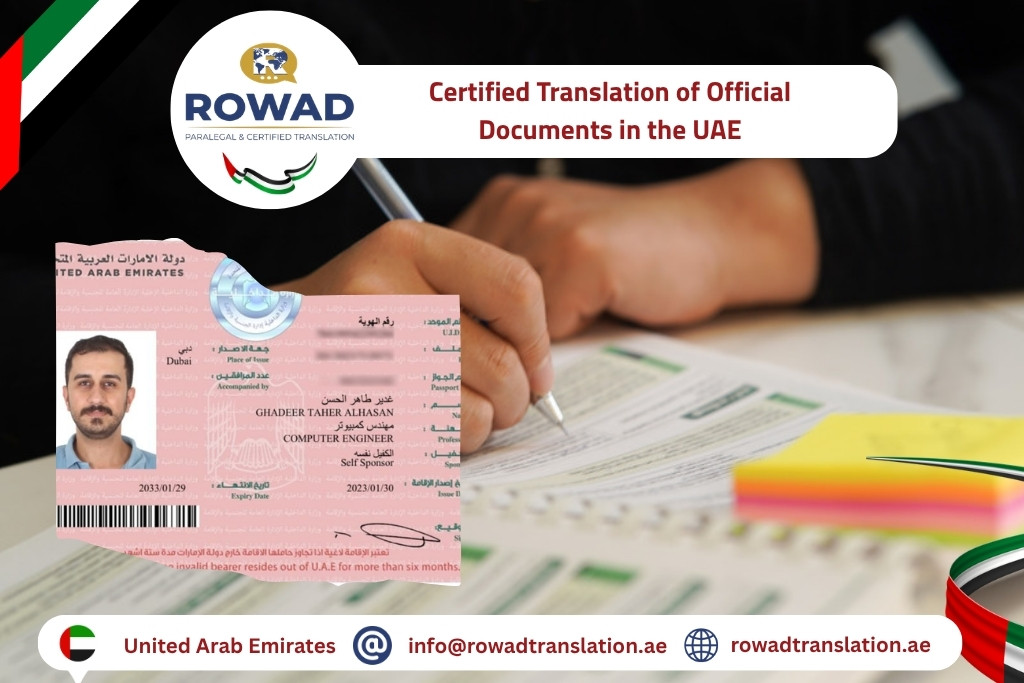
Passports, residence visas, driving licenses, Emirates IDs, and entry permits. These are translated for HR onboarding, embassy procedures, employment cases, and country transfers.
4. Legal and Court Documents
Contracts, powers of attorney, court judgments, claim memos, sworn affidavits, witness statements, indemnity letters, and tenancy contracts. These translations carry strong legal weight, since any inaccuracy can directly affect a court ruling or contractual obligation.
5. Corporate and Commercial Documents
Memoranda of association, articles of association, trade licenses, free-zone licenses, audit reports, partnership agreements, and shareholder resolutions. Required for company formation, license renewals, bank-account openings, and investor onboarding.
6. Medical and Insurance Documents
Medical reports, prescriptions, lab results, surgical reports, and overseas-treatment documents. Hospitals, insurance providers, and UAE health authorities like DHA, DOH, and MOHAP request certified translations whenever a non-Arabic clinical record is involved.
7. Arbitration and Commercial Dispute Documents
Witness statements, expert reports, bilingual exhibits, and procedural correspondence used in arbitration centres such as DIAC and ADCCAC. These cases demand exceptional precision and consistent terminology.
Certified vs General Translation: Why the Difference Matters
It is easy to confuse certified translation with regular translation, but they serve very different purposes. A general translation is acceptable for marketing copy, blog posts, internal documentation, or personal reading. A certified translation is a legal artefact, complete with the office’s seal, the translator’s signature, and a formal declaration of equivalence with the source document.
If your document is going to a UAE court, ministry, embassy, university, or notary office, only a certified translation will be accepted. Submitting an uncertified version will, at best, delay your application and, at worst, result in penalties or outright rejection.
When Do You Need MOFA Attestation or Apostille?
A certified translation is not always the final step. If your document was issued outside the UAE or is heading abroad, you may need additional authentication:
- MOFAIC attestation: required for documents leaving the UAE or for foreign documents that need recognition by UAE authorities.
- Hague Apostille: the UAE has joined the Hague Convention, so documents going to member countries can be apostilled instead of going through full chain attestation.
- Embassy attestation: still required for non-Hague countries, where the destination embassy in the UAE must stamp the document.
The Apostille validates the originating document, but it does not replace the translation. You will still need a certified Arabic or target-language translation produced by an MOJ-licensed office. Confirm with the receiving authority whether they require attestation before, after, or on both copies of the translated document.
Step-by-Step: How to Get Certified Translation in the UAE
Working with a professional office turns a stressful task into a smooth process. Here is how Rowad Translation typically handles a certified translation request:
Step 1: Prepare the Source Document
Provide a clear scanned copy or high-resolution photo of every page. Cropped images, blurred text, or partial pages slow the process down because translators may need extra clarification.
Step 2: Request a Quote
Send the document via WhatsApp, email, or our website’s contact form. Within minutes, our team confirms the page count, language pair, delivery time, and final price — no obligation to commit.
Step 3: Translation by a Specialist
The document is assigned to a translator who specialises in your domain — legal, medical, commercial, technical, or academic — to ensure terminology is precise and consistent with UAE practice.
Step 4: Quality Review
A second linguist and a legal proofreader cross-check names, numbers, dates, and references against the original. Even a single typo in a passport number can render a translation unusable, so multiple checkpoints are essential.
Step 5: Sealing and Certification
Once approved, the document is printed on official letterhead, stamped with the office’s seal, signed by the certified translator, and accompanied by a declaration of accuracy. Soft copies (PDF) are also issued for your records.
Step 6: Optional Attestation Support
If your document needs MOJ, MOFA, or embassy attestation, our team coordinates the next steps to save you the trips and queues. Documents going abroad can also be apostilled when applicable.
Quality Standards You Should Expect
Not every translation office delivers the same level of accuracy. Choose a provider that demonstrates:
- Active licensing and registration with the UAE Ministry of Justice.
- Specialised translators per domain (legal, medical, technical, financial).
- Confidentiality and data protection for client documents.
- On-time delivery, with same-day options when needed.
- Multiple communication channels (WhatsApp, phone, email, website).
- Acceptance guarantee at UAE authorities, with free revision if any technical correction is needed.
- Multilingual coverage including Arabic, English, French, Italian, Russian, Turkish, Chinese, Urdu, and more.
Common Mistakes to Avoid When Translating Official Documents
Years of working with UAE clients reveal recurring mistakes that cost time, money, and sometimes lost opportunities. Watch out for the following:
- Relying on machine translation for official paperwork. Online tools cannot replicate UAE legal phrasing or stamping requirements.
- Choosing an uncertified translator. Without an MOJ stamp, your document is invalid and must be re-translated.
- Ignoring attestation requirements. A document may need MOFA or embassy attestation before or after translation depending on its destination.
- Submitting unclear scans. Faded or cropped originals lead to delays and possible mistakes.
- Mismatched names. Every name must match the spelling on the official passport. Translators cannot reinvent transliterations.
- Rushing at the last minute. Same-day work is possible but usually carries an urgency fee. Plan ahead whenever you can.
How Long Does It Take?
Translation timelines depend on the type and length of the document. Typical turnaround times at Rowad Translation include:
- Same day to 24 hours for short personal documents (birth, marriage, passport, ID).
- 24 to 48 hours for full academic transcripts and standard contracts.
- 2 to 5 business days for long corporate documents such as articles of association and partnership agreements.
- Express same-day delivery available on request when timelines are tight.
How Much Does Certified Translation Cost in the UAE?
Translation pricing in the UAE depends on several factors: document type, word count, language pair, urgency, and any extra attestation requirements. Common personal documents are usually charged per page, while long corporate or legal documents are charged per word. Rare languages such as Chinese, Korean, or Japanese typically come at a premium due to limited availability of certified translators.
For an exact quote, share a clear copy of your document with the Rowad team via WhatsApp or email. You will receive an instant, no-obligation price with a confirmed delivery window.
Why Clients Choose Rowad Translation
Choosing a translation partner is more than a service decision — it is a legal one. With Rowad, you get:
- An MOJ-certified translation office with a valid registration number in the UAE.
- A dedicated team of legal, medical, technical, and academic translators.
- Acceptance of every translation by UAE courts, ministries, and authorities.
- Fast response times and reliable delivery commitments.
- Competitive pricing with tailored offers for individuals and businesses.
- Strict confidentiality across every document we handle.
- Customer support in Arabic and English, throughout the day.
Get Your Certified Translation Today
Whether you need to translate a child’s birth certificate, prepare a corporate file for a Dubai mainland setup, or send academic transcripts abroad, Rowad Translation is ready with a certified, accurate, and on-time service approved by the UAE Ministry of Justice. Send your document via WhatsApp, complete the contact form on our website, or call us directly to request a free, instant quote.
Frequently Asked Questions
Do UAE government departments accept machine-generated translations?
No. UAE government bodies, courts, and embassies only accept translations issued by an office certified by the Ministry of Justice and bearing an official stamp and translator signature.
How quickly can I get a birth certificate translated?
Most birth certificates are translated within a few hours and at most one business day, depending on the clarity of the source and the language pair requested.
Do I always need MOFA attestation after translation?
Not always. If the document is for use within the UAE, MOJ certification is usually enough. If you are sending the document abroad, you may need MOFA attestation or a Hague Apostille, depending on the destination country.
Will Rowad’s certified translation be accepted across all the emirates?
Yes. Translations from any MOJ-certified office are accepted in every emirate, including Dubai, Abu Dhabi, Sharjah, Ajman, Ras Al Khaimah, Umm Al Quwain, and Fujairah, by federal and local authorities.
Can I send my document by WhatsApp?
Yes. Rowad accepts documents via WhatsApp and email and starts the quotation and translation process as soon as a clear copy is received.
Does the certified translation require my signature?
No. A certified translation only requires the office’s seal and the translator’s signature. Your signature is not legally required, although you can add one if a specific authority requests it.
Do you handle rare languages?
Yes. Rowad’s network includes certified translators for French, Italian, Spanish, German, Russian, Turkish, Persian, Chinese, Korean, Urdu, and other rare languages.
What is the difference between legal translation and certified translation?
Legal translation refers to the accurate rendering of legal content. Certified translation is when that translation is issued by a translator licensed by the UAE Ministry of Justice and stamped accordingly. Most official documents in the UAE require both: legal accuracy and certification.
Do you offer pickup and delivery?
Yes. Rowad offers pickup and delivery within the UAE for most documents and provides electronic delivery for clients who prefer to handle everything remotely.
How can I verify that a translation office is truly certified by the Ministry of Justice?
Every certified office in the UAE has a valid Ministry of Justice registration number printed on its official stamp. You can request to view the licence at any time before assigning your work.